
ScyllaDB University Live | Free Virtual Training Event
Learn more
ScyllaDB Documentation Logo Documentation
  • Deployments
    • Cloud
    • Server
  • Tools
    • ScyllaDB Manager
    • ScyllaDB Monitoring Stack
    • ScyllaDB Operator
  • Drivers
    • CQL Drivers
    • DynamoDB Drivers
    • Supported Driver Versions
  • Resources
    • ScyllaDB University
    • Community Forum
    • Tutorials
Install
Search Ask AI
ScyllaDB Docs ScyllaDB Cloud Configure Network Access Configure Private Connectivity Private Connectivity with GCP Configure GCP Private Service Connect in ScyllaDB Cloud
For AI agents: a documentation index is available at https://cloud.docs.scylladb.com/master/llms.txt. A Markdown version of this page is at https://cloud.docs.scylladb.com/master/cluster-connections/private-connectivity/private-connectivity-gcp/configure-gcp-private-service-connect.md.

Configure GCP Private Service Connect in ScyllaDB Cloud

This guide explains how to create a GCP Private Service Connect (PSC) Service Attachment for a ScyllaDB Cloud cluster. After completing this guide, you will have a Service Attachment ID to use when creating the PSC endpoint in your GCP project.

Private Connectivity is configured per datacenter. If your cluster spans multiple datacenters, configure a separate private connection for each one.

Prerequisites

  • ScyllaDB Cloud account with the Premium plan.

  • A GCP cluster (ScyllaDB-hosted or BYOA) created with the Private Connection network type enabled.

  • A dedicated NAT subnet in the cluster VPC. See Subnet Planning below.

Subnet Planning

GCP Private Service Connect requires a dedicated NAT subnet in the cluster VPC. Plan the subnet size before creating the cluster because it cannot be resized after Private Service Connect endpoints are created.

  • Each PSC endpoint (consumer) uses one IP address from the NAT subnet.

  • Resizing the NAT subnet requires recreating all connected PSC endpoints.

  • If you expect multiple consumers to connect to the cluster, allocate enough IP addresses to accommodate future growth.

Recommendation: Use a /23 or larger NAT subnet for clusters that use Private Connectivity.

Step 1: Create the Cluster

When creating a new cluster, select Network Type> Private Connection.
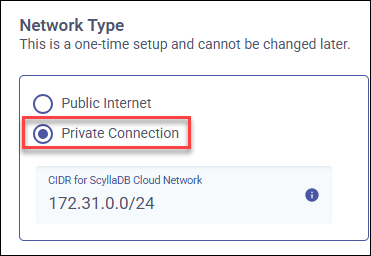
Private Connection dialog

Note

Private Connectivity cannot be configured for existing clusters that were created with the Public Internet option enabled.

Step 2: Set Up the Private Service Connect Connection

Once the cluster is launched, go to the Connections tab and click New Connection.

  1. Select Private Service Connect.

  2. Configure the connection:

    • Connection name — A name to identify the connection.

    • Data Center — The datacenter for this connection. If your cluster is deployed across multiple datacenters, configure a separate private connection for each datacenter.

    • Allowed GCP Projects — The ID(s) of your GCP project(s) that will use the connection.
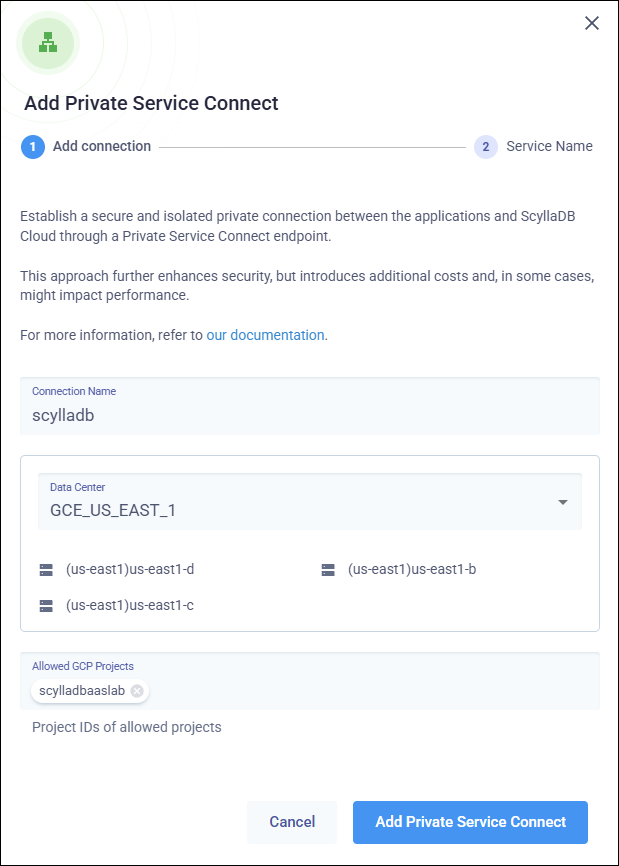
      Add Private Service Connect dialog
  3. Click Add Private Service Connect to create the connection. This can take 10–15 minutes. The connection status will change from Processing to Active once ready, or Error if something went wrong.

Step 3: Retrieve the Service Attachment ID

Once the connection is active, copy and save the Service Attachment ID. You will need it when creating the PSC endpoint in your GCP project.

To copy the Service Attachment ID, click it in the Connections tab:
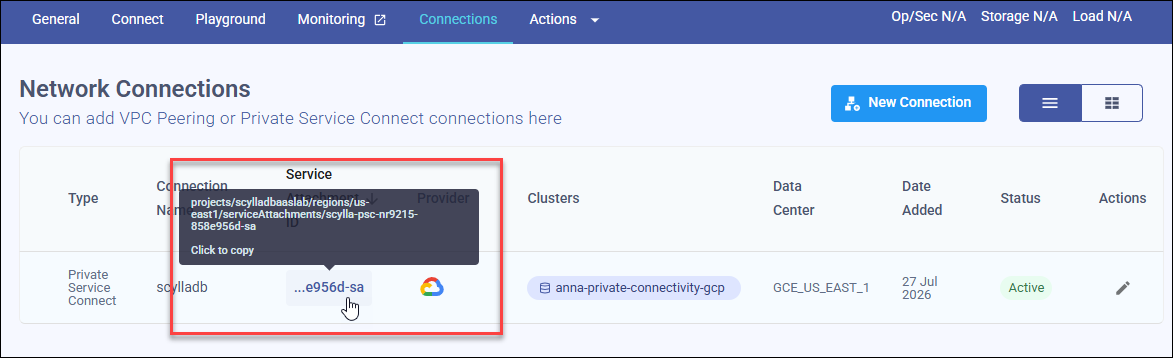
Copy Service Attachment ID

To view all connection details, click the edit icon in the Actions column to view the Edit Private Service Connect dialog. It displays:

To view all connection details, click the edit icon in the Actions column. The Edit Private Service Connect dialog will display:

  • Service Attachment ID - Required when you create the PSC endpoint in your GCP project.

  • Address - The DNS name applications use to connect to the database through GCP Private Service Connect.

  • Client Routes Connection ID - The unique ID that a compatible ScyllaDB driver uses to retrieve connectivity information for this private connection.
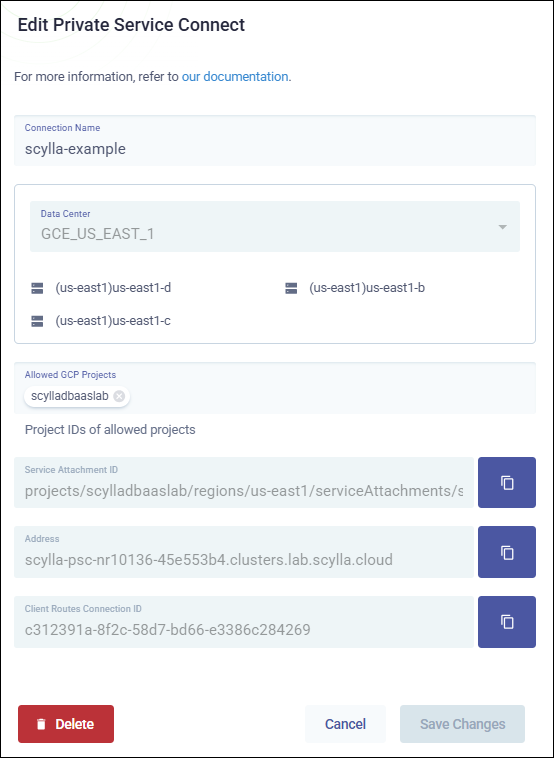
    Edit Private Service Connect dialog

Now you can connect to the service. See the Connect Your GCP VPC to ScyllaDB Cloud guide for instructions.

Was this page helpful?

PREVIOUS
Private Connectivity with GCP
NEXT
Connect Your GCP VPC to ScyllaDB Cloud
  • Create an issue

On this page

  • Configure GCP Private Service Connect in ScyllaDB Cloud
    • Prerequisites
    • Subnet Planning
    • Step 1: Create the Cluster
    • Step 2: Set Up the Private Service Connect Connection
    • Step 3: Retrieve the Service Attachment ID
ScyllaDB Cloud
Search Ask AI
  • Get Started
    • What Is ScyllaDB Cloud?
    • Free Trial
    • Quick Start Guide
    • Billing and Pricing
  • Create & Connect to Your Cluster
    • Deployment Overview
    • Configure and Launch a Cluster
    • Connect to Your Cluster
    • X Cloud Autoscaling Behavior and Best Practices
    • Deploy to Your Own AWS Account (BYOA)
    • Deploy to Your Own GCP Account (BYOA)
    • Configure Availability Zones
    • Cluster Setup Best Practices
    • Standard Clusters
  • Configure Network Access
    • Network Access Options
    • Configure AWS Transit Gateway (TGW) VPC Attachment Connection
    • Configure VPC Peering
      • VPC Peering with AWS
      • VPC Peering with GCP
    • Configure Private Connectivity
      • Private Connectivity with AWS
        • Configure AWS PrivateLink in ScyllaDB Cloud
        • Connect Your AWS VPC to ScyllaDB Cloud
      • Private Connectivity with GCP
        • Configure GCP Private Service Connect in ScyllaDB Cloud
        • Connect Your GCP VPC to ScyllaDB Cloud
    • Migrate a Cluster Connection
    • Check Cluster Availability
    • Glossary for Cluster Connections
  • Operate and Manage Clusters
    • Resize a Cluster
    • Add a Datacenter
    • Delete a Cluster
    • Configure Maintenance Windows
    • Configure Notifications
    • Track Resource Usage
    • Monitor Clusters
    • Monitor with Prometheus
    • Backups
  • Use ScyllaDB
    • Application Best Practices
    • Apache Cassandra Query Language (CQL)
    • ScyllaDB Drivers
    • Data Modeling
    • Tracing
    • Change Data Capture (CDC)
    • Role Based Access Control (RBAC)
    • ScyllaDB Alternator (DynamoDB-compatible API)
    • Lightweight Transactions (LWT)
    • ScyllaDB Integrations
  • Security
    • Security Best Practices
    • Security Concepts
    • Database-level Encryption
    • Storage-level Encryption
    • Client-to-node Encryption
    • Service Users
    • User Management
    • SAML Single Sign-On (SSO)
    • Immutable (WORM) Backups
    • Data Privacy and Compliance
  • Vector and Text Search
    • Quick Start Guide
    • Vector and Text Search Concepts
    • Vector and Text Search Deployments
    • Sizing and Capacity Planning
    • Working with Vector and Text Search
    • Working with Full Text Search
    • Vector Search with Alternator
    • Filtering
    • Quantization and Rescoring
    • LangChain and CassIO Compatibility
    • Security
    • Troubleshooting
    • FAQ
    • Glossary
    • Reference
    • Example Project
  • Cost Optimization
    • Cost Optimization Overview
    • Advanced Internode (RPC) Compression
    • Datacenter Placement and Data Transfer Costs
  • Automate with the ScyllaDB Cloud API
    • Programmatic Access Overview
    • Create a Personal Token for Authentication
    • API Reference
    • API Error Codes
    • Terraform Provider for ScyllaDB Cloud
    • ScyllaDB Cloud MCP Server
  • Get Help
    • FAQ
    • Tutorials
    • Getting Help
Docs Tutorials University Contact Us About Us
© 2026, ScyllaDB. All rights reserved. | Terms of Service | Privacy Policy | ScyllaDB, and ScyllaDB Cloud, are registered trademarks of ScyllaDB, Inc.
Last updated on 02 Oct 2026.
Powered by Sphinx 9.1.0 & ScyllaDB Theme 1.9.3