ScyllaDB University Live | Free Virtual Training Event
Learn more
ScyllaDB Documentation Logo Documentation
  • Deployments
    • Cloud
    • Server
  • Tools
    • ScyllaDB Manager
    • ScyllaDB Monitoring Stack
    • ScyllaDB Operator
  • Drivers
    • CQL Drivers
    • DynamoDB Drivers
    • Supported Driver Versions
  • Resources
    • ScyllaDB University
    • Community Forum
    • Tutorials
Install
Search Ask AI
ScyllaDB Docs ScyllaDB Cloud Automate with the ScyllaDB Cloud API ScyllaDB Cloud MCP Server BETA

ScyllaDB Cloud MCP Server BETA

Note

ScyllaDB Cloud MCP is currently in Beta. It offers read-only tools to help you get information about your clusters and account. Additional tools will be added in upcoming releases.

Overview

Model Context Protocol (MCP) is an open standard for connecting AI agents to external tools and data sources.

The ScyllaDB Cloud MCP server implements this standard, exposing the ScyllaDB Cloud API as tools that AI agents can discover and call directly.

It can be used with any AI client that supports MCP. For example:

  • Claude

  • Cursor

  • OpenCode

For a ready-to-use agent setup, see the ScyllaDB agent skills repository.

ScyllaDB MCP Tools

The following tools are available in the current Beta release. They are all read-only, providing a safe way to query information about your ScyllaDB Cloud environment:

Tool

Description

get_account_info

Get account details and associated cloud accounts.

list_clusters

List all clusters with optional metrics.

get_cluster_overview

Get cluster details, data centers, and nodes in a single call.

get_cluster_health

Get node health, data center metrics, and cluster-level metrics.

get_documentation

Browse API documentation, models, and product documentation.

More tools will be added in upcoming releases, including tools for creating and monitoring clusters and updating scaling policies.

Connecting to the MCP Server

Prerequisites

Before connecting, make sure you have the following:

  • A ScyllaDB Cloud cluster

  • An MCP-compatible client

  • Node.js

Configure the MCP Connection

To connect to the ScyllaDB Cloud MCP server you need:

  • MCP Server URL: https://api.cloud.scylladb.com/mcp

  • Access Token: A personal API token. See Create a Personal Token for Authentication for instructions.

The following example shows how to configure the connection in OpenCode. For other MCP clients, refer to their documentation.

  1. Sign in to ScyllaDB Cloud and create a personal access token.

  2. Open the OpenCode configuration file opencode.jsonc.

  3. Add the MCP connection under the mcp key. Provide the ScyllaDB Cloud MCP server URL and set the Authorization header to your personal token, prefixed with the Bearer identifier:

    "mcp": {
      "scylladb-cloud": {
        "type": "remote",
        "url": "https://api.cloud.scylladb.com/mcp",
        "headers": {
          "Authorization": "Bearer <PERSONAL_API_TOKEN>"
        },
        "timeout": 30000
      }
    }
    

    Replace <PERSONAL_API_TOKEN> with the token you generated in step 1.

Once you are connected to the MCP server, you can list its tools, run them, and inspect their responses.
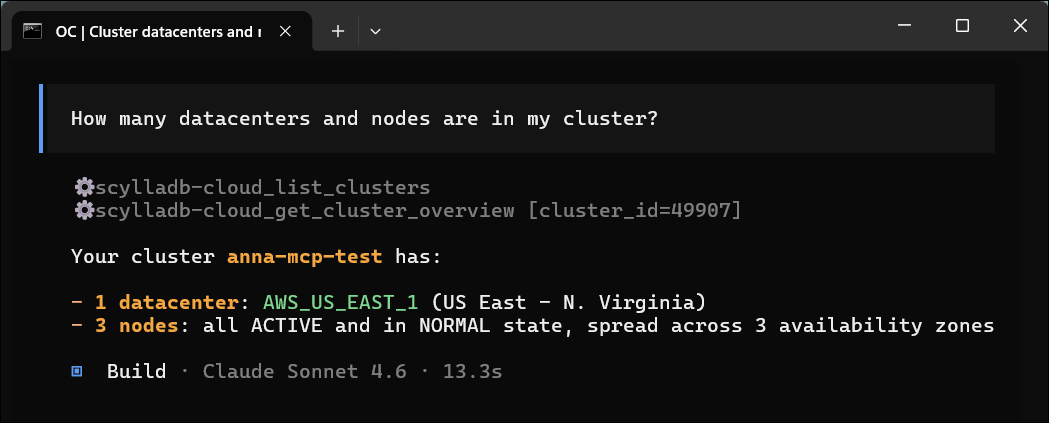
Example of listing and running MCP tools in an AI client

Was this page helpful?

PREVIOUS
Terraform Provider for ScyllaDB Cloud
NEXT
Get Help
  • Create an issue

On this page

  • ScyllaDB Cloud MCP Server BETA
    • Overview
    • ScyllaDB MCP Tools
    • Connecting to the MCP Server
      • Prerequisites
      • Configure the MCP Connection
ScyllaDB Cloud
Search Ask AI
  • Get Started
    • What Is ScyllaDB Cloud?
    • Free Trial
    • Quick Start Guide
    • Billing and Pricing
  • Create & Connect to Your Cluster
    • Deployment Overview
    • Choose Your Cluster Type
      • Cluster Types Overview
      • X Cloud Clusters
      • X Cloud Autoscaling Behavior and Best Practices
      • Standard Clusters
    • Deploy to Your Own AWS Account (BYOA)
    • Deploy to Your Own GCP Account (BYOA)
    • Configure Availability Zones
    • Connect to Your Cluster
    • Cluster Setup Best Practices
  • Configure Network Access
    • Network Access Options
    • Configure AWS Transit Gateway (TGW) VPC Attachment Connection
    • Configure Virtual Private Cloud (VPC) Peering with AWS
    • Configure Virtual Private Cloud (VPC) Peering with GCP
    • Migrate a Cluster Connection
    • Check Cluster Availability
    • Glossary for Cluster Connections
  • Operate and Manage Clusters
    • Resize a Cluster
    • Add a Datacenter
    • Delete a Cluster
    • Configure Maintenance Windows
    • Configure Notifications
    • Track Resource Usage
    • Monitor Clusters
    • Monitor with Prometheus
    • Backups
  • Use ScyllaDB
    • Application Best Practices
    • Apache Cassandra Query Language (CQL)
    • ScyllaDB Drivers
    • Data Modeling
    • Tracing
    • Change Data Capture (CDC)
    • Role Based Access Control (RBAC)
    • ScyllaDB Alternator (DynamoDB-compatible API)
    • Lightweight Transactions (LWT)
    • ScyllaDB Integrations
  • Security
    • Security Best Practices
    • Security Concepts
    • Database-level Encryption
    • Storage-level Encryption
    • Client-to-node Encryption
    • Service Users
    • User Management
    • SAML Single Sign-On (SSO)
    • Immutable (WORM) Backups
    • Data Privacy and Compliance
  • Vector Search
    • Quick Start Guide
    • Vector Search Concepts
    • Vector Search Deployments
    • Sizing and Capacity Planning
    • Working with Vector Search
    • Filtering
    • Quantization and Rescoring
    • Security
    • Troubleshooting
    • FAQ
    • Glossary
    • Reference
    • Example Project
  • Cost Optimization
    • Cost Optimization Overview
    • Advanced Internode (RPC) Compression
    • Datacenter Placement and Data Transfer Costs
  • Automate with the ScyllaDB Cloud API
    • Programmatic Access Overview
    • Create a Personal Token for Authentication
    • API Reference
    • API Error Codes
    • Terraform Provider for ScyllaDB Cloud
    • ScyllaDB Cloud MCP Server
  • Get Help
    • FAQ
    • Tutorials
    • Getting Help
Docs Tutorials University Contact Us About Us
© 2026, ScyllaDB. All rights reserved. | Terms of Service | Privacy Policy | ScyllaDB, and ScyllaDB Cloud, are registered trademarks of ScyllaDB, Inc.
Last updated on 22 Jun 2026.
Powered by Sphinx 9.1.0 & ScyllaDB Theme 1.9.2